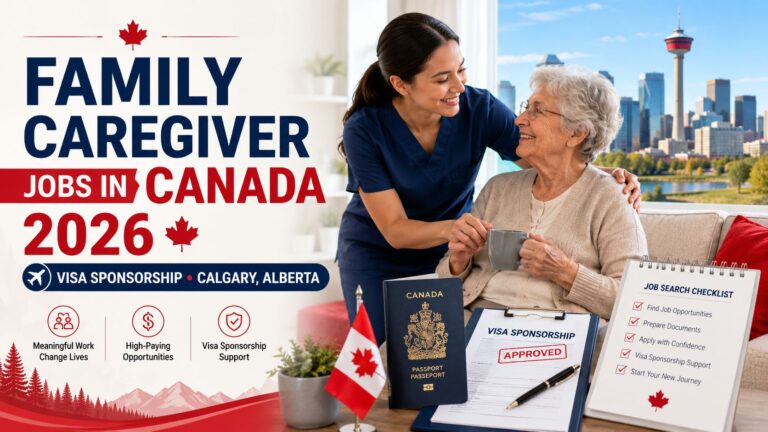
Healthcare Jobs in Canada With Visa Sponsorship – The Roles That Pay the Most, Hire the Fastest, and Lead to Permanent Residency
If you’re a healthcare professional sitting outside Canada right now, wondering whether your qualifications could actually get you a work permit, a salary in Canadian dollars, and a realistic shot at permanent residency — the answer, for most of the roles on this page, is yes.
Canada’s healthcare system is under pressure that isn’t going away. The population is aging. Existing workers are retiring faster than new ones are entering the system. Rural and remote communities are desperate for medical professionals. And the federal government has responded by building immigration pathways that specifically target healthcare workers — pathways that move faster, require lower thresholds, and offer clearer routes to PR than almost any other sector.
Caregiving Jobs for Foreigners in USA – H-1B Visa Sponsorship 2025
Germany 2025: Visa Sponsorship for Unskilled Jobs in Berlin Now Open

Truck Driver Jobs in Canada with Visa Sponsorship

How To Apply For €100,000 Grants & Jobs With Visa Sponsorship In The Netherlands…
Unskilled Jobs in New Zealand with Visa Sponsorship Opportunities in 2025

Australia Work Permit Visa 2025 Requirements: A Comprehensive Guide for Applicants
This isn’t a vague promise. It’s a structural reality backed by policy, funding, and employer demand. Let’s break down which roles are hiring, what they pay, what you need to qualify, who’s sponsoring, and how to get from where you are now to a job offer in Canada.
Why Healthcare Is Canada’s Fastest Lane Into the Country
Every immigration consultant will tell you that healthcare is a “priority sector.” But what does that actually mean for your application?
It means three things. First, healthcare occupations consistently appear on federal and provincial immigration target lists, which means Express Entry draws and Provincial Nominee Programs actively pull healthcare workers out of the pool ahead of other applicants. Second, healthcare employers are among the most experienced LMIA applicants in the country — they know the paperwork, they know the timelines, and they’ve done it before. Third, multiple immigration streams exist specifically for healthcare and caregiving roles, including pilot programs with direct PR pathways that bypass the usual points competition entirely.
The practical effect is that a qualified nurse, lab technician, pharmacist, or personal support worker with the right documentation can move from application to work permit significantly faster than someone in a non-priority occupation — sometimes in as little as six months.
That speed advantage compounds over time. The sooner you arrive, the sooner you accumulate Canadian work experience, which further strengthens any future permanent residency application. Healthcare is one of the rare sectors where the immigration system actively works in your favour at every stage.
The Six Highest-Demand Healthcare Roles — And What Each One Actually Pays
Not all healthcare jobs are created equal. Here’s where the demand is strongest, what you’ll earn, and what’s required to qualify.
Registered Nurses (RNs) remain the single most in-demand healthcare profession in Canada. The government’s own labour projections flag nursing as facing a strong risk of shortage through 2033. Salaries range from $70,000 to $100,000 per year depending on province and specialization, with experienced nurses in critical care and emergency departments pushing well above that range. You’ll need a bachelor’s degree in nursing, registration with a provincial nursing body (such as the College of Nurses of Ontario), and a passing score on the NCLEX-RN exam. Language requirement is CLB 7 or higher, typically demonstrated through IELTS Academic or CELBAN. The residency pathway runs through Express Entry under the Federal Skilled Worker Program or the Canadian Experience Class.
Personal Support Workers (PSWs) and Caregivers are the entry point that most people overlook — and it may be the smartest move on this list. With Canada’s aging population driving explosive growth in long-term care and home care, PSWs are in constant demand. Salaries range from $35,000 to $50,000 per year, which is modest compared to nursing — but the qualification barrier is remarkably low: a high school diploma, a PSW certificate (which can be completed in Canada), and CPR/first aid certification. The language threshold is just CLB 5, and the residency pathway is the Home Support Worker Pilot Program, which offers an open work permit with a direct route to permanent residency after 24 months of qualifying work. For someone without advanced credentials who wants a legitimate path into Canada, this is it.
Physicians and Specialists sit at the top of the salary scale at $150,000 to $300,000 or more per year. The demand is especially acute in family medicine and in rural communities that struggle to attract doctors. But the qualification process is the most demanding on this list: you’ll need credential evaluation, licensing exams (MCCQE Part I and II, plus the NAC OSCE), and certification from the Medical Council of Canada. Language requirement is CLB 7 or higher. Residency pathways include Provincial Nominee Programs and Express Entry, and several provinces offer dedicated physician recruitment streams with relocation support.
Medical Laboratory Technologists earn $60,000 to $80,000 per year and work behind the scenes in hospitals and diagnostic labs — running tests, analysing samples, and generating the data that physicians rely on for diagnosis and treatment. You’ll need a diploma or degree in medical laboratory science and certification from the Canadian Society for Medical Laboratory Science (CSMLS). Language requirement is CLB 7. Express Entry and PNPs are both viable residency pathways.
Physiotherapists earn $65,000 to $90,000 per year and are increasingly needed as Canada’s population ages and demand for rehabilitation services grows. Qualification requires a degree in physiotherapy, credential recognition through the Canadian Alliance of Physiotherapy Regulators (CAPR), and provincial licensure. Language requirement is CLB 7 or higher, with permanent residency available through the Federal Skilled Worker Program.
Pharmacists round out the list at $80,000 to $110,000 per year. Every province needs pharmacists, and rural communities are especially short-staffed. You’ll need a pharmacy degree, a passing score on the Pharmacy Examining Board of Canada (PEBC) evaluating exam, and provincial licensure. Language requirement is CLB 7 or higher, and residency pathways include Express Entry and the Atlantic Immigration Program.
The Companies That Actually Sponsor Foreign Healthcare Workers
Knowing which employers have a track record of hiring internationally — and successfully navigating the sponsorship process — saves you from wasting applications on companies that won’t follow through. These six are known for it.
SE Health (Saint Elizabeth Health Care) hires nurses, PSWs, and physiotherapists across Ontario, British Columbia, and Alberta. They provide LMIA support for foreign applicants and have an established international recruitment pipeline.
Bayshore HealthCare operates nationwide and hires home care nurses, PSWs, and therapy aides. They offer LMIA-based recruitment and settlement assistance, making them one of the more foreigner-friendly employers in the sector.
Vancouver Coastal Health recruits RNs and allied health professionals in British Columbia, with international recruitment programs that include relocation support. If you’re targeting BC specifically, they should be on your shortlist.
Northern Health (BC) serves northern British Columbia communities and hires nurses and diagnostic technicians. They actively use the BC Provincial Nominee Program to sponsor foreign workers — a strong pathway for candidates who don’t mind rural or remote placements.
Saskatchewan Health Authority hires nurses, physicians, and lab technicians across Saskatchewan. They use the Saskatchewan Immigrant Nominee Program (SINP) employer-driven stream, which is one of the more accessible provincial pathways for healthcare workers.
Nova Scotia Health Authority recruits physicians, nurses, and diagnostic imaging staff, and they sponsor through the Atlantic Immigration Program — a streamlined pathway for workers in Atlantic Canada with lower barriers than some national programs.
Immigration Pathways: Which Program Fits Your Situation
This is where healthcare workers have a genuine advantage over most other occupations. Multiple pathways exist, and several of them were designed with healthcare professionals in mind.
Express Entry is the flagship federal system, covering the Federal Skilled Worker Program and the Canadian Experience Class. It’s a points-based system scored through the Comprehensive Ranking System (CRS), and healthcare occupations receive priority in targeted draws. Processing time is approximately six months, and it leads directly to permanent residency.
Provincial Nominee Programs (PNPs) allow individual provinces to nominate workers in occupations they need most. Provinces like Saskatchewan, Nova Scotia, and British Columbia actively target healthcare workers. A provincial nomination adds 600 points to your CRS score, which essentially guarantees selection in the next Express Entry draw.
The Atlantic Immigration Program (AIP) covers New Brunswick, Nova Scotia, Prince Edward Island, and Newfoundland and Labrador. It requires a job offer from a designated employer plus language and education eligibility, and it’s particularly accessible for nurses and caregivers.
The Home Support Worker Pilot is the golden ticket for PSWs and caregivers. It offers an open work permit — meaning you’re not tied to a single employer — with a direct pathway to permanent residency after 24 months of qualifying work. No points competition, no CRS scores. Just work the hours and apply.
The Rural and Northern Immigration Pilot (RNIP) targets healthcare workers willing to settle in smaller communities. Language and points thresholds are lower than national programs, and employers in participating towns actively recruit internationally.
How to Apply: The Sequence That Actually Works
The process has clear steps, and doing them in the right order matters. Here’s the sequence.
Step 1: Get your credentials evaluated. Use World Education Services (WES) or another designated agency to have your foreign qualifications assessed against Canadian standards. This is required for virtually every immigration pathway and most regulatory bodies.
Step 2: Apply for professional certification. Contact the relevant regulatory body for your occupation — the College of Nurses of Ontario for RNs, CSMLS for lab technologists, CAPR for physiotherapists, PEBC for pharmacists. Each province has its own licensing process, and some require bridging programs or supervised practice before granting full licensure. Start this early — it’s the longest step.
Step 3: Complete language testing. Book your IELTS, CELBAN, or CELPIP exam and aim for the score your occupation requires. For most healthcare roles, that’s CLB 7. For PSWs, it’s CLB 5. Don’t underestimate this step — a score that’s one band too low can delay your entire application by months.
Step 4: Search for jobs and apply broadly. Use the Canada Job Bank, health authority websites, Indeed Canada, and LinkedIn. Search for your specific occupation plus keywords like “LMIA,” “visa sponsorship,” or “international recruitment.” Apply to multiple employers across multiple provinces. Volume matters — especially early in the process when you’re building connections.
Step 5: Secure a job offer from a sponsoring employer. This is the critical milestone. A formal job offer from an employer willing to process an LMIA or participate in a PNP employer stream unlocks the work permit application. Everything before this step is preparation; everything after it is execution.
Step 6: Apply for your work permit or permanent residency. Depending on your pathway — LMIA-based work permit, Express Entry, PNP, AIP, or a pilot program — submit your application through IRCC. Processing times vary, but healthcare applications often receive expedited handling.
Step 7: Relocate and register. Upon arrival in Canada, register with your province’s regulatory authority, complete any remaining licensing requirements, and begin work.
The Bigger Picture: Why This Matters Beyond the Job
A healthcare job in Canada isn’t just a paycheque. It’s a credential that compounds over time. Every month of Canadian work experience strengthens your permanent residency application. Every professional connection you build expands your options. And once you hold PR status, you gain access to Canada’s full range of social benefits, can sponsor family members, and eventually qualify for citizenship.
For healthcare professionals specifically, Canada offers something rare: a country that genuinely needs your skills, has built legal infrastructure to bring you in, and rewards you with a clear path to staying permanently. The demand isn’t going to decrease — demographics guarantee that. The pathways aren’t going to close — political consensus supports them. The only variable is whether you act on it.
Start Applying — Direct Job Links
These two resources list current, verified healthcare positions in Canada that are open to foreign workers with LMIA sponsorship:
APPLY ONLINE on ===> On Official Website
APPLY ONLINE on ===> ON Official Website